
Technical Anatomy and Organoleptic Profile of Ibérico Ham
The study of the parts of an Ibérico ham leg is fundamentally an analysis of its muscular anatomy and the resulting variation in fat distribution—factors that determine the organoleptic profile (flavor, aroma, texture) of each section. An Ibérico Ham leg is a complex system where quality is segmented according to the pig’s biomechanics and the curing gradient.
? 100% Acorn-Fed Ibérico!
Buy Acorn-Fed 100% Ibérico Ham from Spain
Enjoy pieces sourced from free-range pigs raised in the oak forests of Huelva, slowly cured to achieve an unforgettable bouquet.
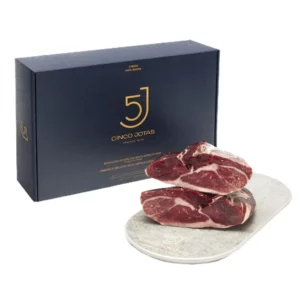
Take Advantage of This Offer on CINCO JOTAS Acorn-fed 100% Ibérico Boneless Ham!
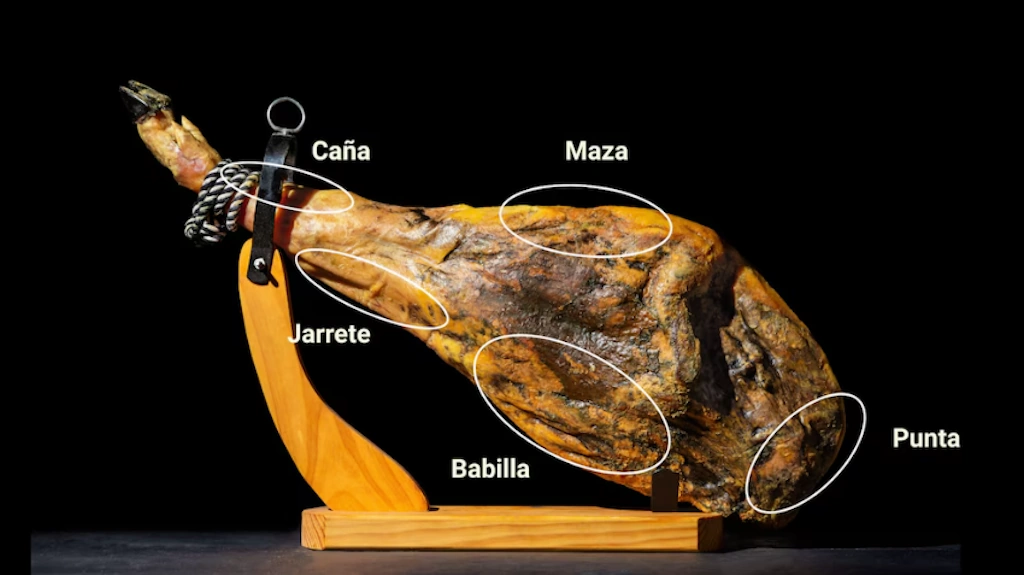
The leg is divided into three main anatomical—and by extension, commercial—regions:
Maza (Main or Cushioned Section)
This is the widest and meatiest section, corresponding to the Biceps Femoris and Semimembranosus muscles. Oriented toward the top part and opposite the hip bone, it features the highest concentration of infiltrated and intermuscular fat.
This fat, rich in oleic acid (up to 55%), melts at low temperatures, resulting in intense marbling. It offers an intense, sweet, and lingering taste. Here you will find the deepest flavors due to the longer curing duration and higher proportion of acorn fat, which facilitates the formation of aromatic esters and aldehydes. It is exceptionally juicy, smooth, and melt-in-the-mouth; the fat infiltration imparts a characteristic friability (easily crumbling in the mouth). Boasting an elevated and complex aroma, it is the area of highest aromatic intensity. As the largest section, its slicing yield is superior, maintaining its quality for longer once the ham is opened.
Contramaza / Babilla (Rump / Stifle Section)
Located opposite the Maza, adjacent to the hip bone (Ischium), it corresponds to the Vastus Lateralis and Rectus Femoris muscles. It has less intramuscular fat compared to the Maza and lighter external fat coverage, with more elongated and compact muscles. Less intense and slightly saltier, the thinner muscle and fat layers allow faster and deeper salt penetration during salting, even though the curing process is equally long. It is firmer, less juicy, and offers greater resistance to chewing.
The absence of prominent marbling makes this meat leaner. It tastes less complex, “cleaner,” and more direct. This section is ideal to begin slicing if consumption will be slow, preventing the prized Maza from drying out prematurely.
Punta (Tip / Crown Section)
The final extremity of the piece (opposite the hoof), located near the pelvic bone, is an area of significant muscle convergence. It exhibits a very high concentration of superficial fat alongside excellent infiltration in the muscles near the hip. Extremely potent and flavorful, it typically reaches a point of higher curing and controlled salinity, resulting in a rich, pronounced taste.
Featuring a very luscious and unctuous texture, the high proportion of fat dissolved into the muscle makes it extraordinarily smooth. The aroma is concentrated with more evolved nuances due to the convergence of fats and the overall morphology of the leg.
Secondary and Transitional Zones
- Jarrete (Hock): The muscular section near the hoof, primarily formed by flexor muscles and tendons. Its meat is fibrous and firm, yet highly aromatic due to bone proximity and intense curing. Ideal for dicing into small cubes (taquitos) or snacking.
- Codillo (Shank / Shin): The section connecting the Hock to the Maza. Highly valued for its heavy fat covering and dense infiltration, it delivers a flavor intermediate between the Maza and the Hock, with a fibrous texture that turns luscious as the fat melts.
- Bone/Marrow: The bones, particularly the femur and hip (coxal), play a vital role in maturation. The lipid-rich bone marrow imparts additional volatile compounds to the surrounding muscle, intensifying the final aroma.

Enjoy the True Flavor of the Spanish Dehesa
Organoleptic Summary of the parts of Iberian Ham
An Ibérico ham leg presents an organoleptic gradient ranging from the juiciest and sweetest section (Maza) to the most intense and cured parts (Punta and Jarrete). The muscle-to-infiltrated-fat ratio (which is highest in the Maza and Punta) and dehydration kinetics (faster in the Contramaza) are the technical drivers behind these distinct profiles. The art of the master ham artisan lies in managing the curing process so this full spectrum of flavors reaches its maximum potential. By requiring extended minimum curing periods, PDO standards ensure that even the leanest cuts develop a fully realized aromatic profile.